

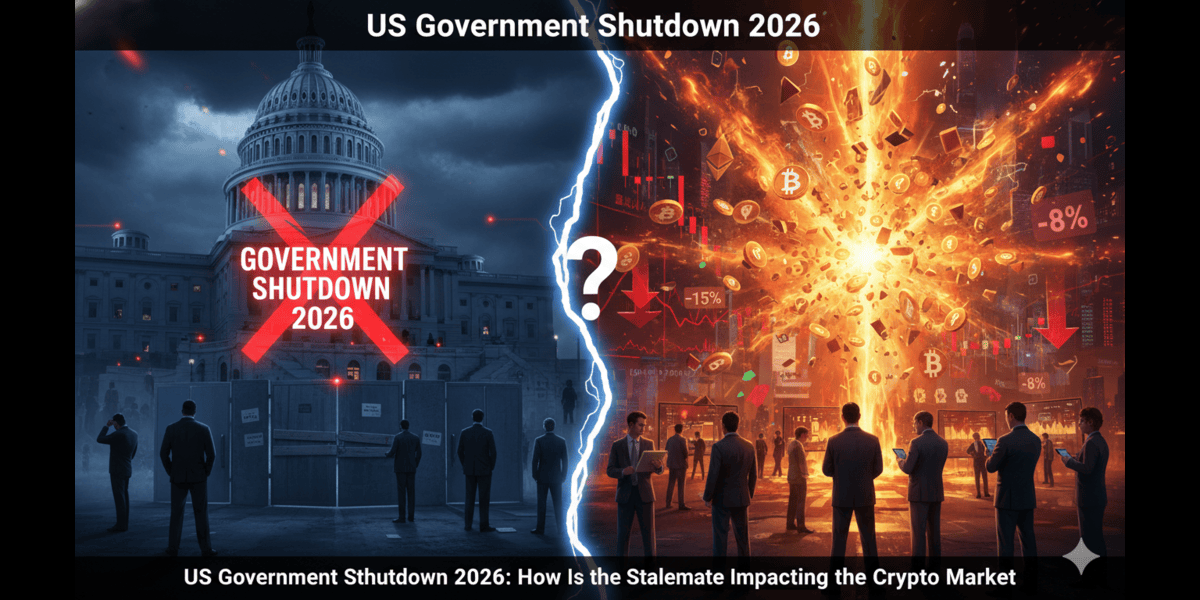
The United States officially entered a partial government shutdown at 12:01 a.m. on January 31, 2026, following the House of Representatives’ failure to pass a Senate-approved spending package. This political deadlock has triggered immediate consequences for the digital asset sector, creating a “data vacuum” for traders and freezing critical regulatory progress at the SEC and CFTC. As investors react to the uncertainty, the crypto market is experiencing heightened volatility, significant ETF outflows, and a pause on major legislative bills like the CLARITY Act.
How Is the Shutdown Affecting Bitcoin Prices and Market Liquidity?
The news of the shutdown has shifted market sentiment into a state of “Extreme Fear,” driving capital away from risk-on assets like cryptocurrency and toward traditional safe havens such as gold.
- Bitcoin Price Correction: Leading into the shutdown, Bitcoin (BTC) prices fell roughly 7%, testing the critical support range of $81,000–$83,000 as traders de-risked their portfolios.
- Massive Liquidations: The volatility resulted in a massive leverage flush. On January 30 alone, over $1.68 billion in total crypto liquidations occurred, with long positions accounting for 93% of the wipeout.
- ETF Outflows: Institutional caution is evident in the spot market. Spot Bitcoin ETFs recorded net outflows totaling approximately $818 million in a single day as large-scale investors moved to the sidelines to await political clarity.
Why Does the Shutdown Freeze Crypto Regulations and Economic Data?
A prolonged shutdown halts the “administrative machinery” of the U.S. government, which has a direct downstream effect on crypto regulation and economic forecasting.
- SEC & CFTC Freeze: Both the Securities and Exchange Commission (SEC) and the Commodity Futures Trading Commission (CFTC) have transitioned to “emergency-only” staffing. This effectively pauses the review of at least 16 spot crypto ETF applications—including highly anticipated filings for Solana and Litecoin—and halts the issuance of new “no-action” letters.
- Legislative Delays: The Digital Asset Market Structure Bill (also known as the CLARITY Act), which was poised for a breakthrough in Q1 2026, is now stalled. Congressional focus has pivoted entirely to resolving the budget deadlock, delaying vital industry legislation.
- The “Data Vacuum”: The suspension of federal agencies means the release of critical economic reports—such as CPI inflation data and Non-Farm Payrolls—will be delayed. Without these macro signals, crypto traders lack the guidance needed to predict Federal Reserve interest rate moves, leading to “choppy” and unpredictable price action.
Frequently Asked Questions
Will the government shutdown crash Bitcoin prices further?
While short-term volatility is high, the impact depends on the duration of the shutdown. Currently, the market is pricing in “Extreme Fear,” pushing Bitcoin down to the $81,000 range. However, if the shutdown resolves quickly—with a House vote expected as early as February 2, 2026—prices may stabilize. Conversely, a long-term stalemate could test the thesis of Bitcoin as a “non-correlated” asset.
How does the shutdown affect pending Crypto ETF approvals?
The shutdown effectively pauses the approval clock. With the SEC operating with minimal staff, the review process for new products, including Solana and Litecoin ETFs, is halted. No new approvals or regulatory guidance will be issued until full government funding is restored and agencies return to normal capacity.
Is Bitcoin considered a safe haven during a government shutdown?
Historically, this is debated. While some investors view Bitcoin as “Digital Gold” that should rise when the fiat system looks dysfunctional, the current market reaction shows a correlation with risk assets. In the immediate term, liquidity concerns are driving investors toward cash and physical gold rather than crypto, though this could shift if the shutdown extends for weeks.
Conclusion
The January 2026 government shutdown serves as a significant stress test for the mature crypto market. With over $1.68 billion in liquidations and a freeze on SEC regulatory progress, the event highlights the sector’s continued sensitivity to U.S. fiscal dysfunction. Traders should remain cautious of the “data vacuum” and monitor the upcoming House vote on February 2, as the restoration of government operations is the primary catalyst needed to bring stability back to digital asset prices and resume the industry’s legislative momentum.
Disclaimer: The information provided is not trading advice, Bitcoinworld.co.in holds no liability for any investments made based on the information provided on this page. We strongly recommend independent research and/or consultation with a qualified professional before making any investment decisions.
