

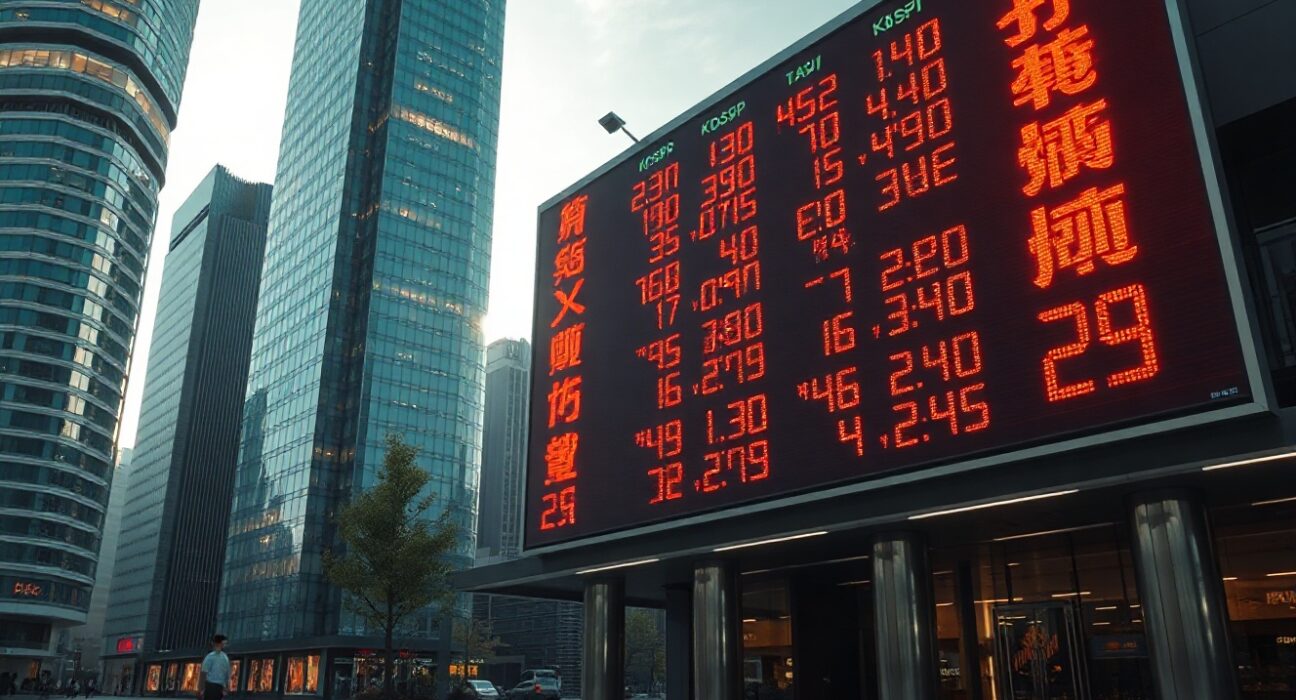
Asian stock markets traded in a mixed pattern on Thursday, as lingering geopolitical uncertainty surrounding US-Iran relations tempered investor risk appetite across the region. South Korea’s KOSPI index bucked the trend, surging sharply on the back of strong gains in technology and battery manufacturing stocks.
Geopolitical Cloud Hovers Over Regional Sentiment
Markets from Tokyo to Shanghai opened cautiously after renewed diplomatic signals between Washington and Tehran failed to provide clear direction. While no major escalation has been reported, the lack of a definitive resolution has kept traders on edge, limiting upside momentum in most Asian bourses.
Japan’s Nikkei 225 edged lower, pressured by a slight strengthening of the yen and profit-taking in export-oriented sectors. Hong Kong’s Hang Seng Index also slipped, dragged by real estate and financial shares. Mainland China’s Shanghai Composite remained nearly flat as investors awaited further policy cues from Beijing.
KOSPI Outperforms on Tech and Battery Strength
South Korea’s benchmark KOSPI index rose more than 1.5% in afternoon trading, marking its best session in weeks. The rally was led by heavyweight semiconductor and electric vehicle battery makers, which attracted strong buying from both domestic institutions and foreign investors.
Analysts attributed the surge to expectations of sustained global demand for advanced chips and battery components, as well as relative insulation from direct US-Iran tensions. The Korean won also held steady, providing additional support for foreign inflows.
What This Means for Investors
The divergence between the KOSPI and its regional peers underscores how sector-specific dynamics and domestic fundamentals can outweigh broader geopolitical risks. For investors, the current environment suggests that selective exposure to export-driven technology and clean energy supply chains may offer relative stability amid ongoing macro uncertainty.
Traders are now watching for any fresh diplomatic developments between Washington and Tehran, as well as upcoming economic data from China and Japan, which could set the tone for the remainder of the week.
Conclusion
Asian markets remain caught between geopolitical headwinds and localized growth stories. While the KOSPI’s rally highlights pockets of strength, the broader regional mood is cautious. Investors should brace for continued volatility as US-Iran dynamics evolve and key economic releases approach.
FAQs
Q1: Why did the KOSPI rise while other Asian markets fell?
The KOSPI was boosted by strong gains in technology and battery manufacturing stocks, driven by solid demand expectations and foreign inflows, which offset the cautious sentiment from US-Iran uncertainty.
Q2: How are US-Iran tensions affecting Asian markets?
Geopolitical uncertainty typically reduces risk appetite, leading to cautious trading and lower volumes. Markets in Japan and Hong Kong saw mild declines, while investors await clearer diplomatic signals.
Q3: What should investors watch next?
Key factors include any new developments in US-Iran talks, economic data from China and Japan, and earnings reports from major Korean tech companies that could sustain or reverse the KOSPI rally.
Disclaimer: The information provided is not trading advice, Bitcoinworld.co.in holds no liability for any investments made based on the information provided on this page. We strongly recommend independent research and/or consultation with a qualified professional before making any investment decisions.
